Organic carbon burial in the Japan Trench.
01 / 05
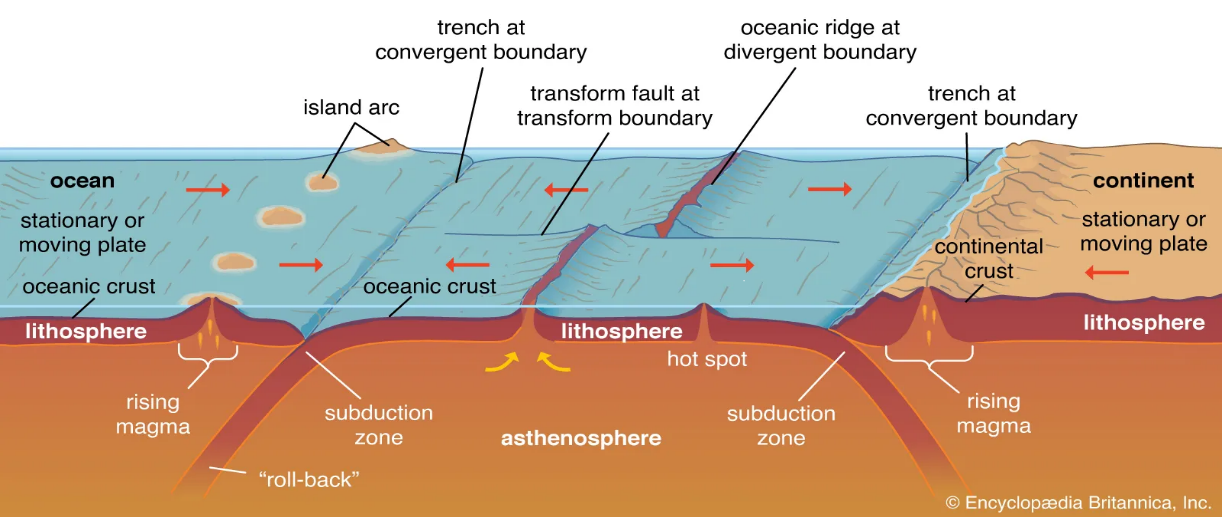 Hadal environment and sediment transport
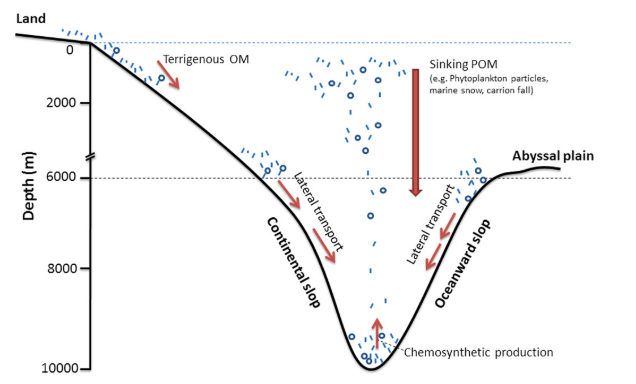 Terrestrial and marine-derived carbon
Earthquakes can remobilise terrestrial and marine organic matter before it is buried in hadal sediments.
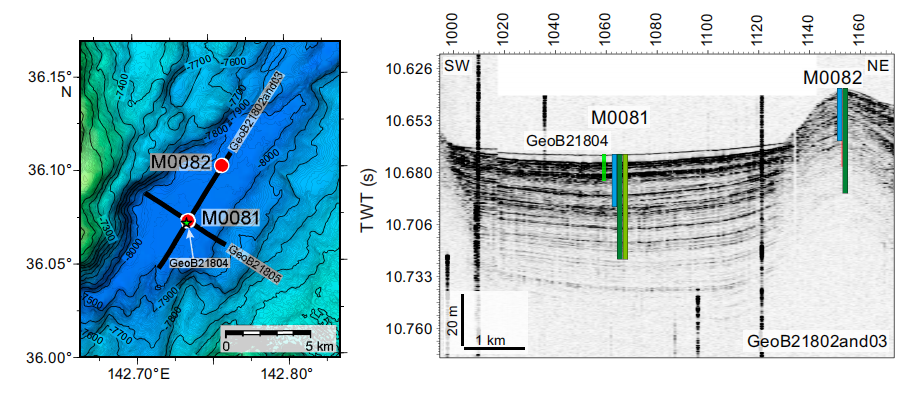 Southern Japan Trench · basin S1
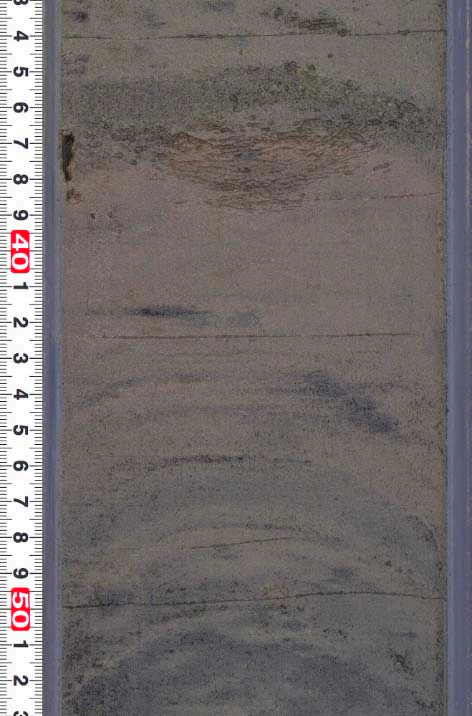 M0082D–24W · ten samples
The selected section contains post-event background, two turbidites and pre-event background sediment.
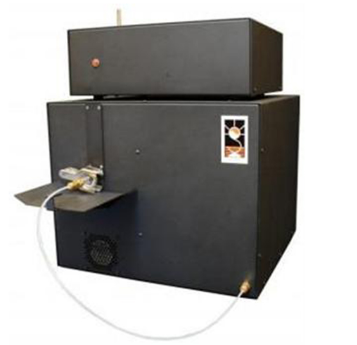 Coupled RPO–CRDS system
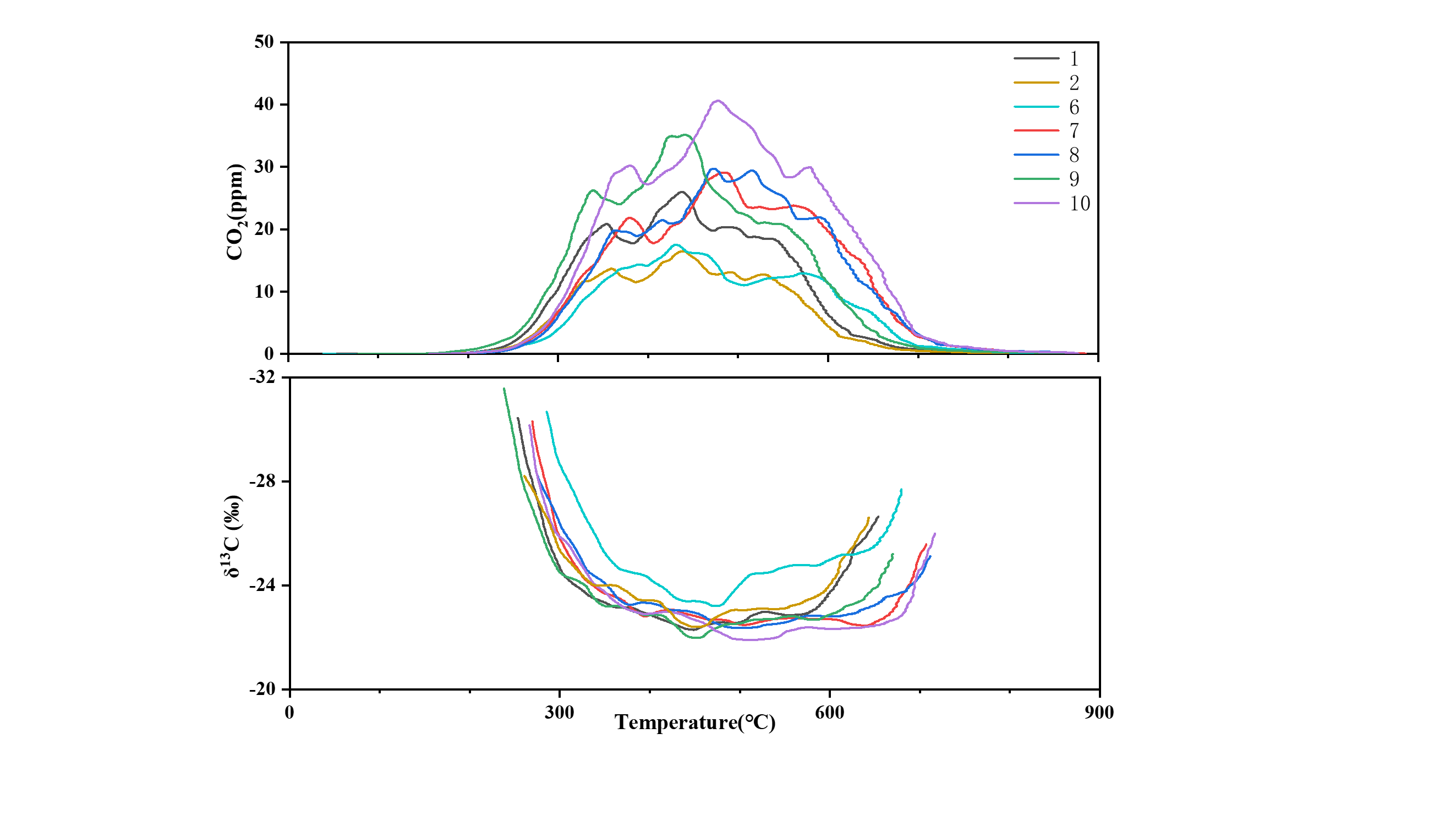 Paired CO₂ and δ¹³C profiles
Ramped heating releases CO₂ while CRDS measures concentration and δ¹³C continuously.
Use the arrows or swipe left and right to compare the complete Gaussian, activation-energy and temperature-window analyses. Select any image to inspect it at full size.
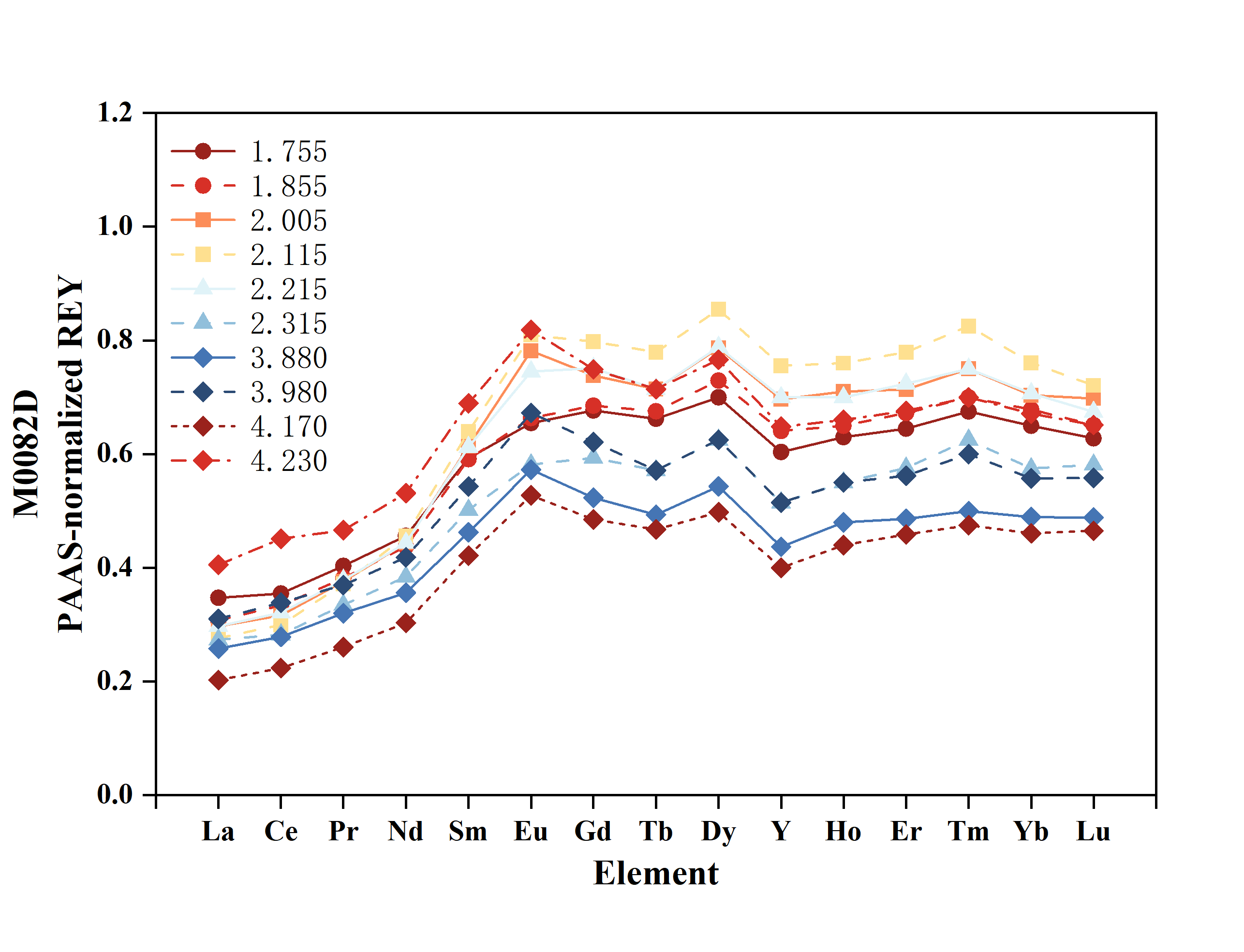 M0082D · sample 23
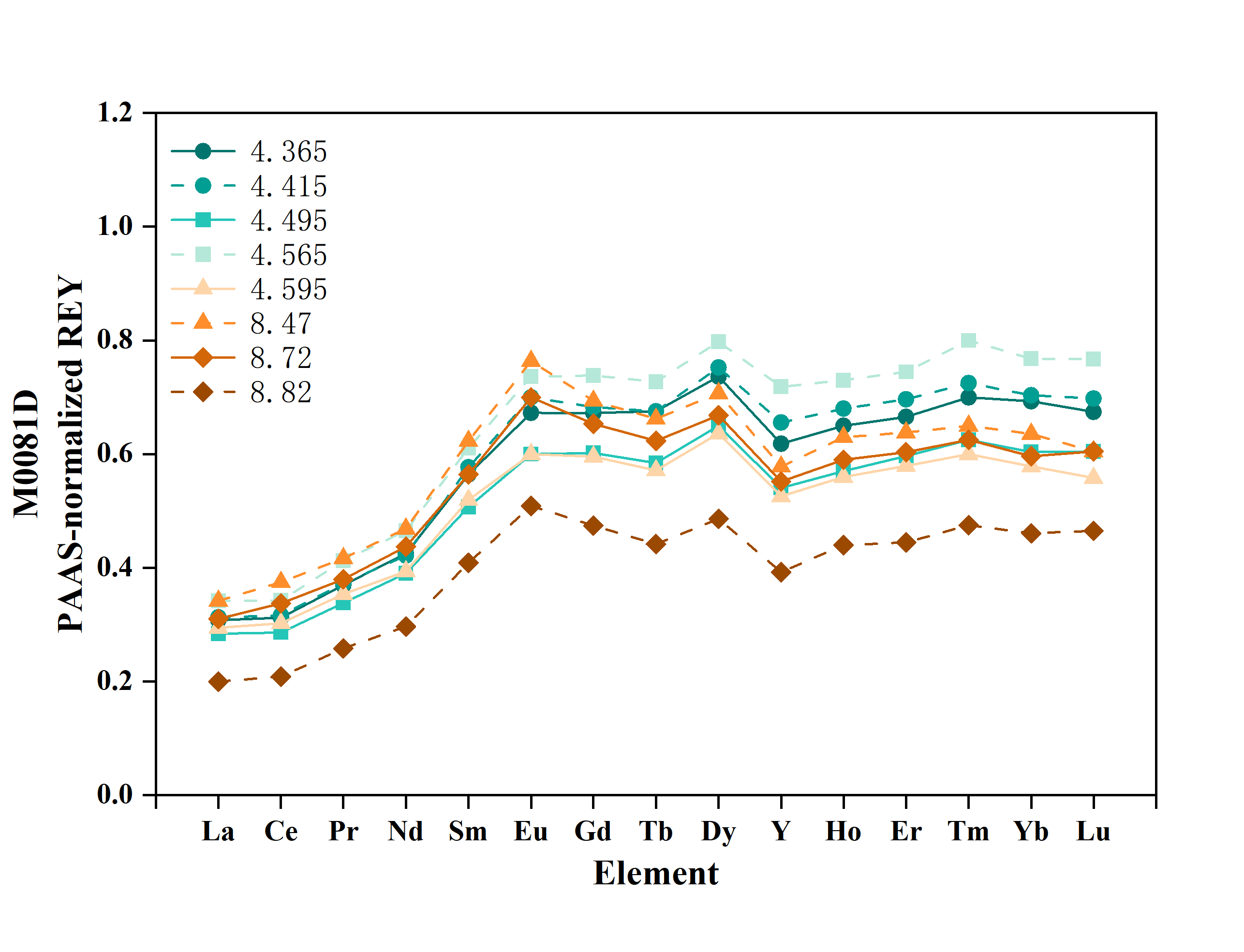 M0081D · sample 08
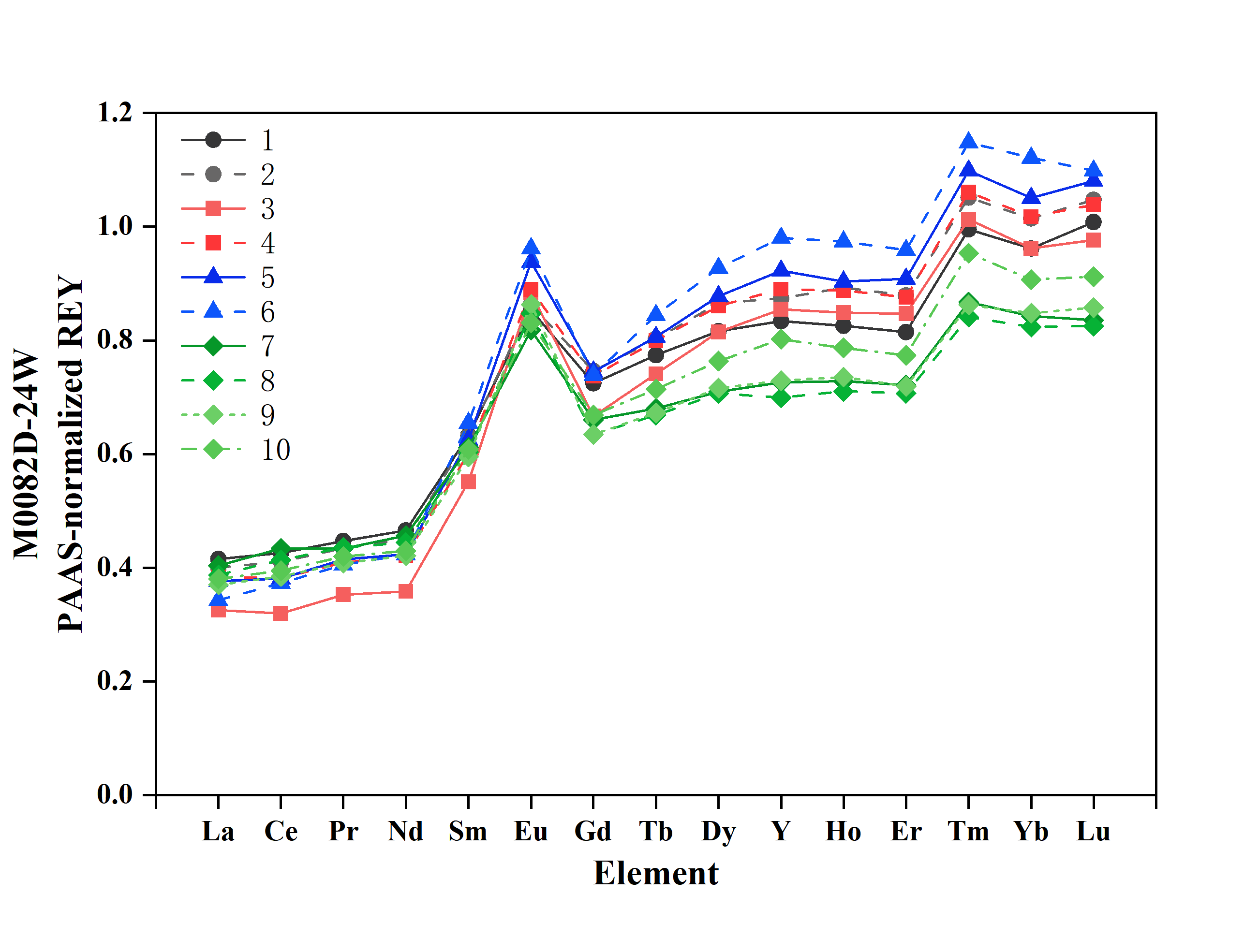 M0082D–24W · study section
Recurring low-LREE patterns near event tops guide the search for depositional or diagenetic mechanisms.
Carbon Burial Context
Earthquake-driven sediment transport can mix carbon from different sources and histories.
The Japan Trench is a hadal environment deeper than 6,000 m, with high pressure, low temperature and no sunlight. Organic carbon arrives from both land and marine production.
- Terrestrial carbonEarthquakes can remobilise land-derived organic matter and repeatedly resuspend it during lateral transport.
- Marine-derived carbonPhytoplankton convert dissolved inorganic carbon into sinking organic particles.
- Research questionHow do sedimentary events change organic carbon sources, thermal reactivity and preservation?
Study Site & Samples
Ten samples compare event deposits with the surrounding background sediment.
The material comes from IODP Expedition 386, Site M0082D in the southern Japan Trench. Section 24W spans approximately 23.63–23.94 mbsf at about 8,000 m water depth.
- Location
- 36.100°N · 142.756°E
- Core
- M0082D · section 24W
- Stratigraphy
- Two turbidites with pre- and post-event backgrounds
- Measurements
- Grain size, elements, TOC, δ¹³C, Δ¹⁴C and RPO–CRDS
RPO–CRDS Method
Continuous CO₂ and δ¹³C profiles reveal carbon heterogeneity hidden by bulk measurements.
Ramped pyrolysis and oxidation convert thermally released organic carbon to CO₂. Cavity ring-down spectroscopy then measures CO₂ concentration and δ¹³C online.
- 01Ramped heating
Organic matter decomposes and oxidises across a controlled temperature programme.
- 02Online CRDS
The system records CO₂ release and stable-carbon isotope composition at the same time.
- 03Component-level comparison
Low-, intermediate- and high-temperature fractions can be compared between event and background layers.
Method note: the coupled RPO–CRDS system was developed in our laboratory; my work focuses on applying it and interpreting the profiles.
Three Analysis Routes
I selected three independent treatments to test whether the same event–background pattern persists.
Each method emphasises a different part of the signal and introduces different assumptions. Agreement across methods is more informative than any single curve fit.
- 01Gaussian peak fitting
Compares peak positions and areas, while remaining sensitive to the selected peak number and initial parameters.
- 02Temperature-window integration
Quantifies five operational carbon fractions, with results dependent on the chosen boundaries.
- 03Activation-energy modelling
Compares apparent energy distributions under an assumed kinetic model.
REE Comparison & Scientific Reasoning
Repeated patterns near event tops became a question to investigate, not an instant conclusion.
Comparisons among M0082D, M0081D and M0082D–24W show recurring decreases in overall REY or in LREE relative to HREE near event-layer boundaries.
- 01Compare
Place REE patterns from different cores and intervals on the same basis.
- 02Identify
Look for features that recur near event tops instead of focusing on one isolated sample.
- 03Ask why
Test whether the pattern could reflect depositional sorting, redox change or later diagenesis.
- 04Investigate
Use literature and other geochemical indicators to narrow the possible mechanism.
Interpretive boundary: the recurring REE feature is an observation. The mechanism remains under test.
Current Status
Analysis in progress.
The RPO–CRDS, TOC, stable-isotope, radiocarbon and multi-element results are still being cross-checked. I will report a mechanism only when the independent evidence supports it.
01 / 06