From molecular structure to fluorescence efficiency.
01 / 09
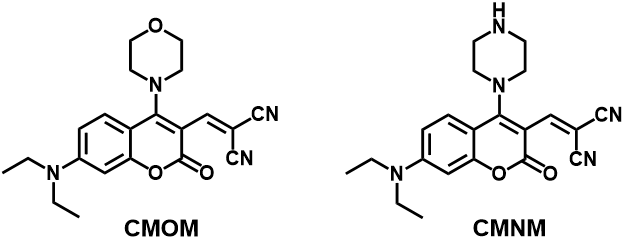
CMOM and CMNM share the same coumarin framework and differ at the heterocyclic substituent.
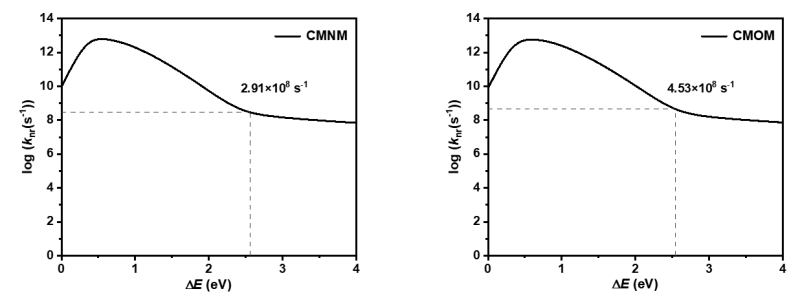
Fluorescence efficiency depends on the balance between radiative emission and non-radiative energy loss.
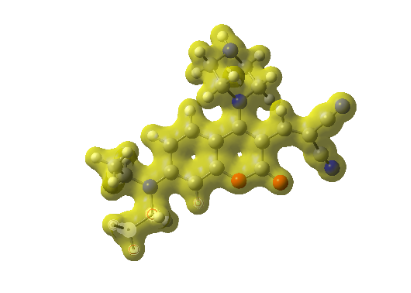 CMOM · morpholine substituent
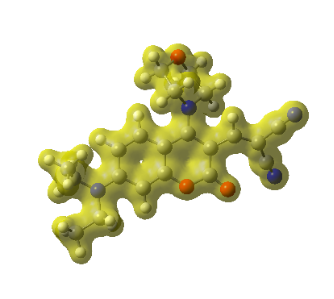 CMNM · piperazine substituent
The conjugated donor–acceptor framework remains constant while the terminal heterocycle changes.
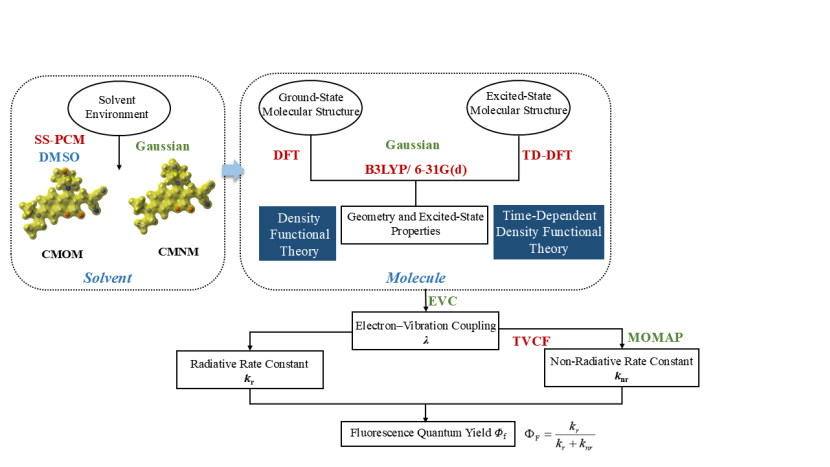
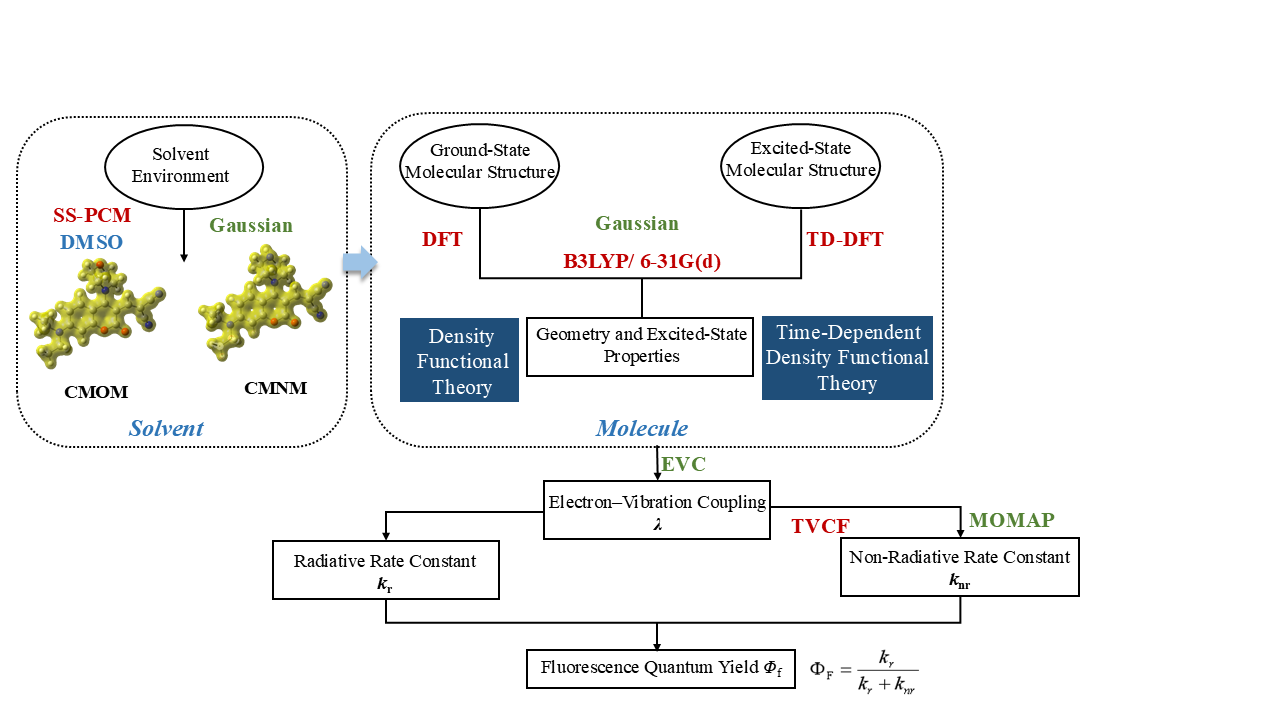
DFT and TD-DFT calculations connect structure, electronic transitions, vibration and fluorescence quantum yield.
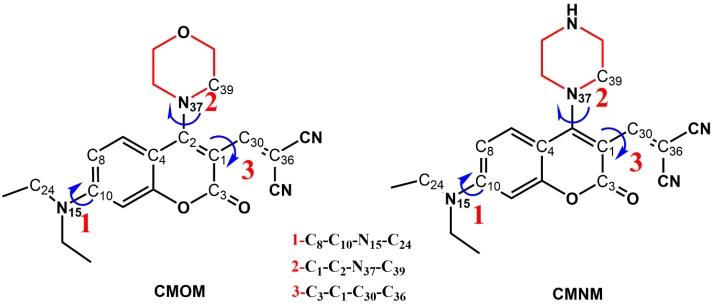 Excited-state geometric relaxation
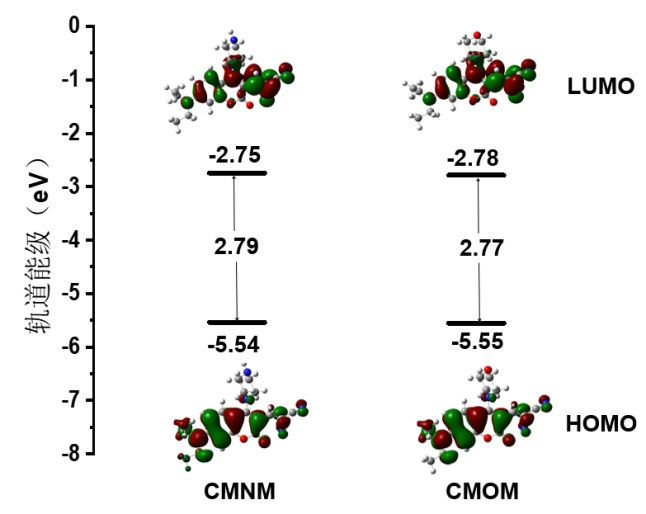 Frontier-orbital distributions
Dihedral changes and frontier orbitals show how excitation reshapes the molecule and redistributes electron density.
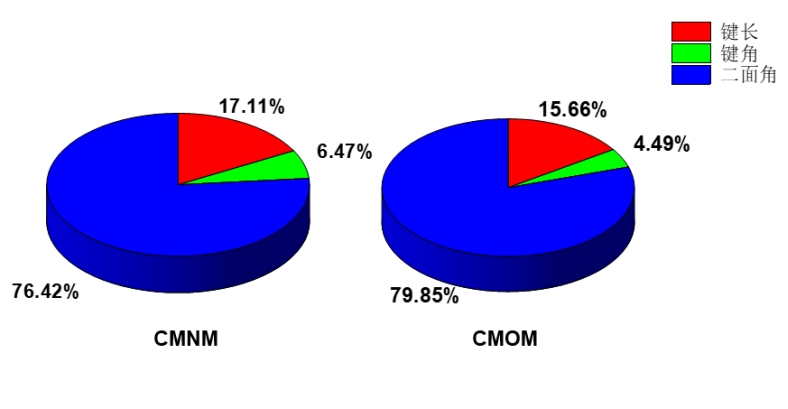 Internal-coordinate contributions
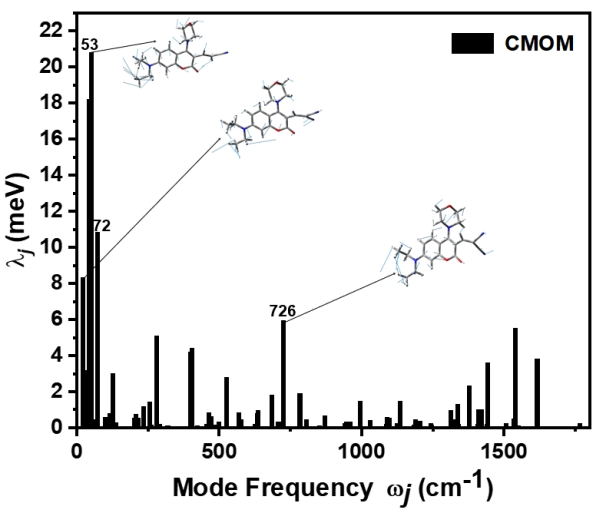 Mode-resolved reorganisation energy
Dihedral relaxation contributes most of the reorganisation energy in both molecules.
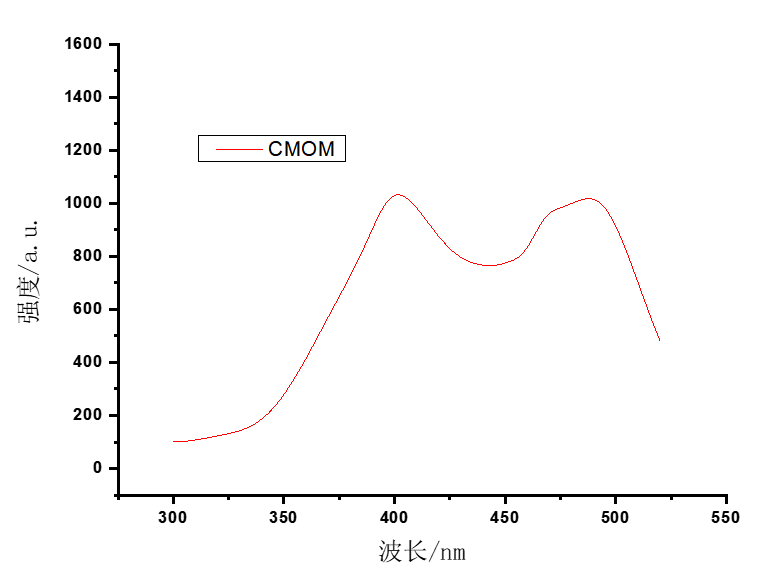 Experimental fluorescence spectrum
 Calculated radiative and non-radiative rates
The theoretical quantum yield was compared with an independent fluorescence measurement for CMOM.
 Provincial programme · Excellent completion · 2023
 University programme · Completed · 2022
Two earlier innovation-training projects established the computational photophysics foundation that led into this thesis.
Project Overview
Two related molecules made one structural change testable.
My undergraduate thesis compared the luminescent behaviour of CMOM and CMNM, two coumarin derivatives that share the same conjugated framework but carry different heterocyclic substituents.
- Period
- 2023–2024
- Role
- Independent calculations and experimental comparison
- System
- CMOM and CMNM in DMSO
Research question: how does replacing morpholine with piperazine change molecular relaxation and fluorescence efficiency?
Research Objective
Predict fluorescence by resolving the pathways that compete after excitation.
After a molecule reaches the first excited state, it can emit a photon or lose energy through molecular motion and internal conversion. I calculated both pathways instead of treating fluorescence as an isolated spectrum.
- Radiative rate, krDerived from emission energy and oscillator strength.
- Non-radiative rate, knrEvaluated through vibrational modes, reorganisation energies and vibronic coupling.
- Fluorescence quantum yield, ΦFCalculated from kr / (kr + knr).
Molecular Design
A shared donor–acceptor framework isolates the effect of ring substitution.
Both molecules contain the same diethylamino donor, coumarin conjugated core and dicyanovinyl acceptor. Only the morpholine or piperazine ring changes.
- 01Diethylamino donor
Supplies electron density to the conjugated system.
- 02Coumarin core
Provides the emissive π-conjugated framework.
- 03Dicyanovinyl acceptor
Supports intramolecular charge-transfer character.
- 04Morpholine or piperazine
Creates the controlled structural difference between CMOM and CMNM.
Computational Workflow
The calculation follows each molecule from its initial structure to competing decay rates.
- 01Initial structures
Build CMOM and CMNM in GaussView and represent DMSO with PCM.
- 02Geometry and vibrations
Optimise S0 with DFT and S1 with TD-DFT, followed by frequency analysis.
- 03Vertical transitions
Calculate absorption and emission energies, oscillator strengths and orbital contributions.
- 04Relaxation analysis
Resolve geometry change, reorganisation energy and radiative or non-radiative rates.
Calculation level: Gaussian 16, B3LYP/6-31G(d), DFT / TD-DFT and PCM (DMSO).
Structure & Electronic Transitions
Excitation mainly changes the acceptor-side torsion and shifts electron density toward the acceptor.
The largest dihedral change occurs where the dicyanovinyl acceptor joins the coumarin core. Absorption and emission remain dominated by HOMO–LUMO transitions.
- Acceptor-side dihedral change15.55° for CMOM and 14.58° for CMNM.
- Dominant transitionMore than 98% HOMO–LUMO character.
- CMOM peaksCalculated at 439 nm absorption and 530 nm emission, compared with 460 and 560 nm experimentally.
- CMNM peaksCalculated at 437 nm absorption and 525 nm emission.
Reorganisation Energy
Dihedral relaxation carries most of the structural reorganisation energy.
Excitation changes several internal coordinates, but torsional motion contributes much more than bond stretching or angle bending.
- CMOMTotal reorganisation energy of 149.51 meV.
- CMNMTotal reorganisation energy of 180.51 meV.
- Dihedral contribution74.3% for CMOM and 76.4% for CMNM.
- Important low-frequency modes53 and 72 cm−1 for CMOM; 43 and 72 cm−1 for CMNM.
Fluorescence Quantum Yield
Internal conversion dominates the reported rate model.
The calculated internal-conversion rates are about two orders of magnitude larger than the radiative rates, explaining the low predicted fluorescence yields.
- CMOM calculatedkr = 2.23 × 10⁸ s−1, kic = 1.28 × 10¹⁰ s−1, ΦF = 1.7%.
- CMOM measuredExperimental fluorescence quantum yield of 1.3%.
- CMNM calculatedkr = 2.28 × 10⁸ s−1, kic = 1.14 × 10¹⁰ s−1, ΦF = 2.0%.
Evidence boundary: CMOM was checked experimentally; equivalent CMNM measurements were not available.
Skills & Learning
I moved from following calculation steps to understanding what each calculation answers.
I built an independent workflow for DFT and TD-DFT calculations, then organised a 49-page personal reference that links each technical step to its scientific purpose.
- Computational practiceGround- and excited-state optimisation, frequency checks, orbital analysis, reorganisation energy and fluorescence-rate calculations.
- Experimental comparisonConnected theoretical results with measured absorption, emission and fluorescence quantum yield.
- Research recognitionExcellent completion in a provincial innovation programme in 2023, following a university innovation project in 2022.
01 / 08